
ECU About Us

The ECU Difference: Financial Health Support, Education-Focused Banking and Member Value

Get to Know ECU and Your Benefits

At Education Credit Union, we belive that everyone deserves a stronger and more sustainable financial future. That’s why we’re built to help you navigate every stage of life. As a credit union, we work together as a community with a shared objective: helping members move forward financially. By understanding your unique needs, challenges, and opportunities, ECU can help accomplish your goals. We invest in our digital tools and deliver the accounts you need, with the service you expect from financial experts. Providing great, local banking isn’t just something we do, it’s at the heart of who we are.

From our humble beginnings as a teacher-focused cooperative, to becoming a cornerstone of community support and financial support, Education Credit Union is proud to be a part of Texas Panhandle history. We’re continuing to write our story, and we look forward to more chapters of innovation, growth, and service.

ECU History Image
ECU History Image

What Does It Mean to Be A Credit Union?

Member-Owned Banking Built for Your Success

Education Credit Union is a not-for-profit financial cooperative, which means we are member-owned and focused on delivering value back to you.

As a credit union, we’re here to help you succeed. Because Education Credit Union is a not-for-profit financial cooperative, we return profits to our members in the form of better rates on loans, great rates on deposits, and low or no fees on our products. We also invest in the communities we serve through volunteer hours and support for schools, organizations, and local initiatives across the Texas Panhandle.

Founded in 1935, we’ve had the privilege of serving our local area with outstanding accounts and services for generations. Today, we are proud to be the largest credit union in the region, trusted by over 40,000 members in Amarillo, Borger, Bushland, Canyon, and Stinnett. Though we were initially founded to serve teachers, over the years our mission has grown. Membership is open to anyone who lives, works, worships, or attends school within 10 miles of any of our locations. For complete details, visit here.

Coming together as one group of people and working together is our goal. From individuals to entire communities, your success is our success.

Borger Ribbon Cutting

Our Mission

To Love Our People with Smarter Banking.

Our Vision

To Be People That Love People into Financial Prosperity.

Core Value

People First, Impact Always!

ACHIEVEMENTS

Proud to be ECU and Deliver the Expertise Recognized by Others

2025

  • Voted Amarillo’s Best Credit Union 20 years in a row!

  • News Channel 10 Viewer’s Choice Award: Best Credit Union

  • Canyon Readers’ Choice Award: Best Credit Union

  • Diamond Award for One-Time Event: Badger $mart Grand Opening Event

  • Education Credit Union was recognized as one of Newsweek’s 2025 America’s Best Regional Banks and Credit Unions

  • Cornerstone League Pinnacle Awards: First place | Video (non-commercial) series | “The Core” podcast

  • Cornerstone League Pinnacle Awards: First place | Logos | “The Core” podcast

2026

  • News Channel 10 Viewer’s Choice Award: Best Credit Union

  • Diamond Award for New Event: School Days Gala (ECU Foundation)

  • Diamond Award for Ongoing Event: Pocket Change Grant Deliveries: Best in Category (ECU Foundation)

  • Education Credit Union was recognized as one of Newsweek’s 2026 America’s Best Regional Banks and Credit Unions

ECU History

Founded in 1935, Built to Help Members Get Ahead
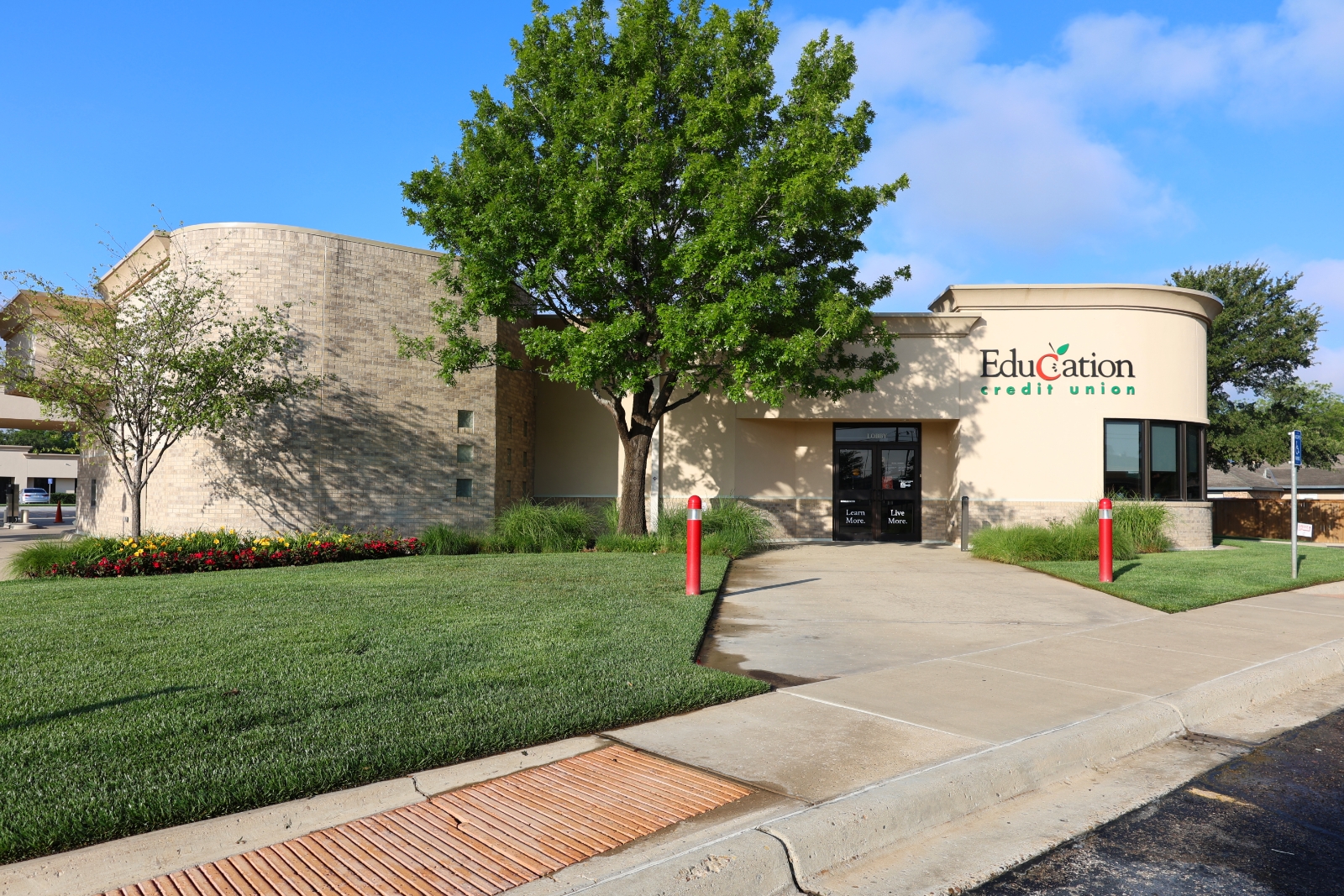
Exterior of the Education Credit Union Hillside Branch

A Clear History of Growth, Success and Member Financial Achievement

Education Credit Union (ECU) was founded on January 19, 1935, when 10 Amarillo teachers formed Amarillo School Employees Credit Union (ASECU) during the Great Depression. Each founder contributed $5, creating $50 in initial capitalization. On March 7, 1935, the state of Texas Department of Banking issued credit union charter #80. We started with a dream of helping members and a goal of improving their financial health and access.

Today, ECU serves more than 40,000 members across 18 counties as a full-service, not-for-profit financial institution. ECU reinvests earnings into the credit union to deliver strong member value through great dividends, competitive rates, and financial products with low or no fees. ECU continues its mission of promoting financial responsibility and accessibility, supported by dedicated board leadership.

ECU History Image

Credit Union Founders and Early Governance

The 10 founding members of ECU also served as the initial Board of Directors:
  • Wayne Middleton (President)

  • R. F. Williams (Secretary-Treasurer and Manager)

  • Hugh Underwood

  • C. C. Walden

  • J. E. Speer

  • T. G. Hull

  • Mary Vivian Cecil

  • T. H. McDonald

  • Elizabeth Nixson

  • I. D. Mahuron

In 1983, the board was reduced to nine directors to avoid voting ties. In 1986, director terms moved to revolving three-year terms, and ASECU adopted the Texas standard bylaws for state-chartered credit unions.

ECU Leadership Timeline

Building a Stronger Financial Institution

Building a Foundation Through Service

ECU’s early growth was shaped by managers R. F. Williams (1935-1949) and S. G. Anthony (1949-1958), who served part-time and supported members before and after school hours. Both served as part-time employees, serving members before or after school hours, conducting a “hip-pocket, shoebox” operation. Williams and Anthony breathed life into the youthful organization, and their dedication helped lay the foundation for what ECU would become.

Expanding Services, Strengthening the Future

Growth accelerated in the 1970s with full-time management. E. M. Savage (1958-1982) became ECU’s first full-time manager. Patricia M. Tomberlin (1982-1997) served as President/Manager and helped shape ECU into the thriving, full-service institution it is today.

Leading ECU Into the 21st Century

Larry D. Cooper (1997-2003) became President/CEO in June 1997 and restructured the leadership team to support a growing membership. The new team included roles such as Vice President of Management Information Systems, Chief Financial Officer, Vice President of Marketing; Vice President of Lending; Vice President of Member Services; Collection Manager; and Teller Supervisor. Gregg R. Bynum (2003-2019) joined in 1997 as Senior Vice President and became President/CEO in 2003 and employee training in compliance practices began in earnest. Eric L. Jenkins served as President/CEO from 2019-2022. In December 2022, Marcus Smith (2022-present) was named President/CEO. Smith had been with ECU for 10 years prior to his promotion, serving as CFO and interim CEO. Before joining ECU, Smith was a Senior Controls Specialist where he was involved in financial audits, internal control testing, regulatory training, and compliance. Raised in Amarillo, Smith and his wife have chosen to raise their family in the community. Marcus received his bachelor’s degree in business from West Texas A&M University.

ECU Branch Growth and Expansion Across the Texas Panhandle

Education Credit Union’s journey began in humble space – ASECU’s first office operated out of R.F. Williams’ Amarillo High School classroom. As membership grew, the credit union expanded to Central Junior High School (later Nixson Junior High School) and Wolflin Elementary School, with limited hours before and after school.

In 1975, ECU purchased its first dedicated building at 119 West 15th Street in Amarillo. At first, the credit union occupied only half of the building. The leadership at the time doubted the operation would ever need more space. However, by 1986, the building was bursting at the seams. The growth in membership, employees, and services had outpaced the space. That November, the board approved plans to build a new headquarters. In 1987, ECU acquired land at 4400 W. Interstate 40, and the I-40 branch opened October 3, 1988.

Innovation and student-focused branches include:
  • AISD AmTech Career Academy student-run branch at 3601 Plains Blvd. (opened August 2022)

  • Second Canyon branch at 1900 FM 2590 (opened October 2022)

  • ECU Buff $mart Branch in Canyon (re-opened March 2023 through partnership with West Texas A&M University)

  • Borger branch at 500 W. Grand St. and Stinnett branch at 102 N. Main St. (expanded May 2023 through partnership with H&H Federal Credit Union)

  • Badger $mart Branch at 512 SW 22nd Ave. on the Amarillo College Washington Street Campus (opened August 2024)

ECU continued expanding with new branches and facilities, including:
  • Canyon Branch on 4th Street (renovated in 2002)

  • Hillside Branch at 6201 Hillside (opened 2003) and Operations Center at 6203 Hillside (opened 2006)

  • Bushland Branch at 1801 S. FM 2381 (built 2007)

  • Plum Creek Branch at 5500 Plum Creek Drive (opened December 1, 2013)

  • 45th Branch at 3615 SW 45th (opened January 2015)

ECU name Changes and Membership Eligibility Expansion

ECU began by serving employees of Amarillo College and the Amarillo and Canyon Public School Districts. Membership expanded over time to include children of members, employees of public and private schools, colleges and universities, plus retired teachers and spouses of deceased members.

1986 – 1989

In December 1986, ECU expanded eligibility to blood and legal relatives of members. Additional employee groups were added, including Opportunity Plan Inc. and Texas Tech University Health Science Center. In 1988, ECU adopted an option allowing small employee groups within 10 miles of headquarters, including High Plains Dermatology Center and Panhandle Alcoholic Recovery Center (added in 1989).

Education Credit Union (ECU) has expanded steadily to serve more members across the Texas Panhandle, while growing assets, upgrading technology and adding modern financial products and services.

1997

In 1997, the credit union changed its name from Amarillo School Employees Credit Union to The Education Credit Union (ECU) to reflect a broader, more inclusive field of membership. In July of that same year, ECU expanded eligibility to include currently enrolled students of higher learning.

2001

In 2001, ECU expanded membership eligibility to include:

  • Employees of all public, private, and parochial schools, colleges, and universities

  • Homeschoolers and certified daycare workers

  • Currently enrolled students of higher learning in Potter, Randall, Armstrong, Carson, Donley, and Oldham counties

  • Blood and legal relatives of eligible employees and students

2004 – 2005

In January 2004, ECU merged with THD District 4 Credit Union, adding 404 new members. In 2005, ECU expanded eligibility to include the AISD PTA Council, the WTAMU Alumni Association, and school employees in Dallam, Deaf Smith, Donley, Gray, Hansford, Hartley, Hemphill, Hutchison, Lipscomb, Moore, Ochiltree, Roberts, and Sherman counties in the Texas Panhandle.

2010 – 2013

In 2010, ECU expanded its charter to serve anyone living, working, worshiping or attending school within 10 miles of the Canyon or Bushland branches. Eligibility also extended to students enrolled in school within the top 16 counties ECU served. In April 2012, ECU broadened membership again to include anyone within 10 miles of the Hillside and I-40 branches.

On July 1, 2013, ECU updated its brand name by dropping “The,” becoming Education Credit Union.

Today!

Today, ECU serves more than 40,000 members across the Texas Panhandle. Anyone who lives, works, worships or attends school within 10 miles of any of ECU’s 11 locations is eligible to join. ECU is your go-to expert financial guidance, expertise and access.

ECU Asset Growth Over Time

From original assets of $50, ECU reached $1 million in assets by 1968.

ECU asset growth over the last 20 years includes:
  • 2003: $95,600,000

  • 2008: $132,500,000

  • 2013: $206,784,000

  • 2018: $258,385,000

  • 2023: $477,792,600

ECU History Image

Education Credit Union Today

Built for Growth and Member Value

Education Credit Union continues to grow through strong leadership, resilient operations and a commitment to exceptional service. ECU remains focused on delivering real value to members through competitive rates, personalized service and a member-first approach guided by “People Helping People.”